Free guide · Designed PDF
Tax Planning for Small Business Owners
Why your tax bill is mostly decided before 30 June, and the plain-English moves worth making while they can still change the number.
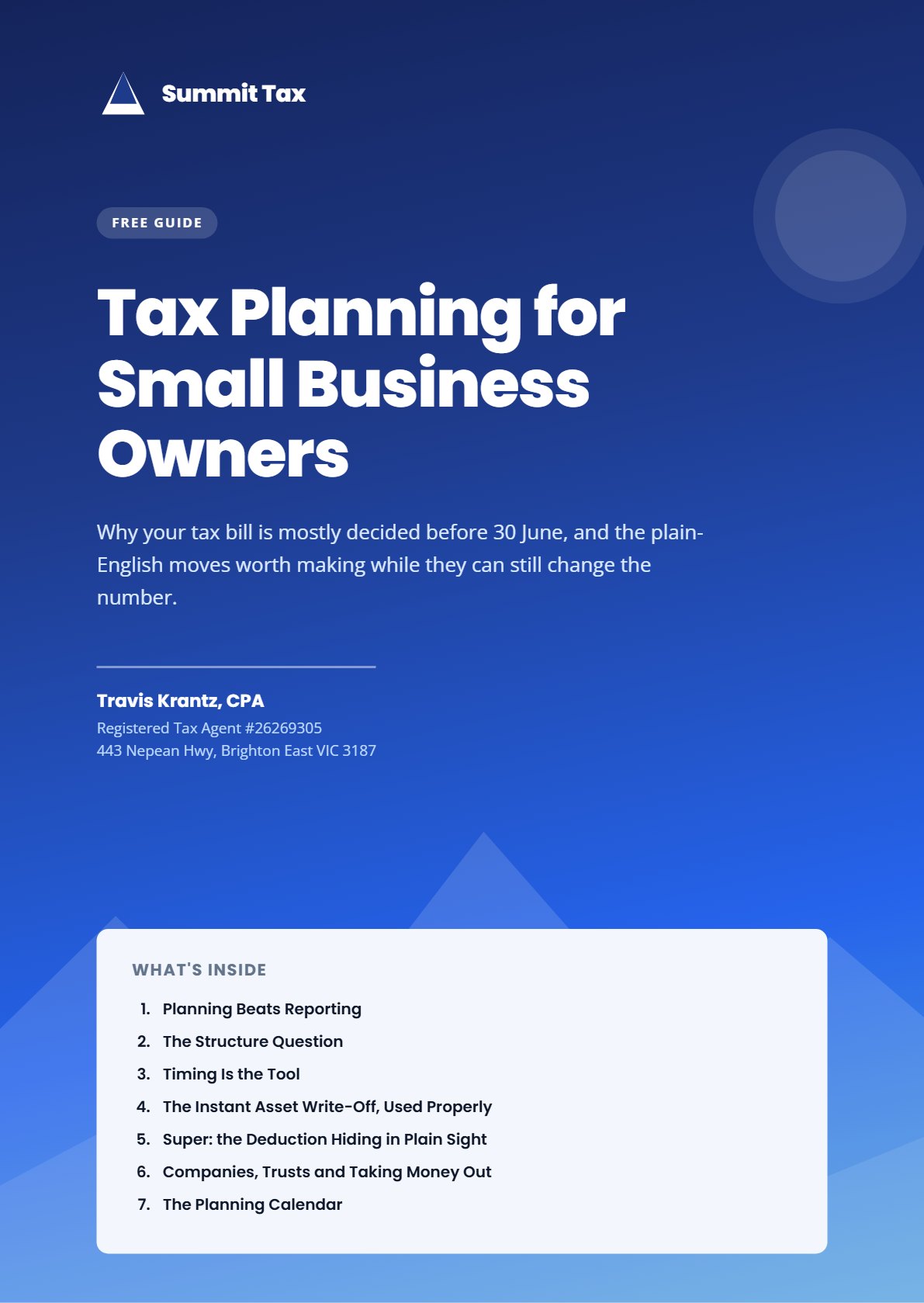
What's Inside the Guide
- Planning Beats Reporting
- The Structure Question
- Timing Is the Tool
- The Instant Asset Write-Off, Used Properly
- Super: the Deduction Hiding in Plain Sight
- Companies, Trusts and Taking Money Out
- The Planning Calendar
Who this one is for
This guide is for the business owner who finds out what they owe in October, for a year that finished in June. By then every decision that could have changed the answer has already been made.
That is not usually anyone's fault. It is just how the year is normally run: you trade, the books get done afterwards, the accountant tells you the result. The problem is that a tax return is a report on decisions, and the decisions all happened months earlier. Structure, timing, what you bought and when, how you paid yourself, whether super went out before the deadline.
So this guide is about the other order. It covers the questions worth asking before 30 June rather than after, what actually moves a tax result and what only feels like it does, and the traps that catch business owners who are trying to do the right thing. It is written the way I would explain it across a desk, without the jargon, and it does not assume you find any of this obvious.
Two businesses, same profit
Two businesses can finish a year with the same profit and pay very different amounts of tax, and the difference is almost never a clever trick. It is that one of them had a conversation in May about what was coming, and the other one found out in October. This guide is the content of that May conversation.
Download the Free Guide
Pop your details in and the designed PDF is yours on the next page.

This guide is for general informational purposes only. It does not constitute personal tax or financial advice, and it does not take into account your objectives, financial situation or needs. Rates, caps and thresholds change; figures in this guide were confirmed against ato.gov.au at the date below. Always consult a registered tax agent for advice specific to your circumstances. Summit Tax is a registered tax agent (26269305). The Tax Practitioners Board maintains a public register of registered tax agents at tpb.gov.au/public-register. If you have a concern about our service, please raise it with us first at info@summittax.com.au; you can also complain to the TPB at tpb.gov.au/complaints. Information current as at September 2026.
Rather talk it through than read about it?
Book a free 30-minute strategy session. Plain English, your actual numbers, no obligation.
Schedule Your Free Strategy Session